Focused attention
Choose one anchor, notice when attention leaves, and return. The return—not perfect focus—is the training repetition.
SPARTAN MONK METHOD / MEDITATION
A practical, evidence-informed meditation system for attention, composure and deliberate action—in stillness, movement and ordinary life.
[ 001 — WHY MEDITATE ]
Modern life trains interruption: messages, pressure, criticism, worry and the next demand. The result is not always a lack of strength. Often, it is a lack of space between stimulus and response.
Meditation trains the ability to recognise what is happening before habit takes command. That matters in conflict, work, family life, physical training and every moment when motivation disappears.
Stillness is where automatic reaction becomes visible—and deliberate response begins.
[ 002 — NOT ONE PRACTICE ]
Different methods train different capacities. Relaxation may arise, but the deeper purpose is awareness: learning to meet experience with presence and choice.
Choose one anchor, notice when attention leaves, and return. The return—not perfect focus—is the training repetition.
Observe thoughts, emotions, sounds and sensations without automatically following, suppressing or solving them.
Use contact points, posture and internal sensation to recognise tension and reactions earlier.
Carry the same quality of attention into walking, standing, training and deliberate transitions.
[ 003 — THE METHOD ]
Notice experience earlier. Create enough space to choose what happens next. Repeat until the skill follows you beyond the practice session.
Establish internal stability before choosing a response.
Use one conscious breath to interrupt automatic behaviour.
Keep attention relaxed while the intention to return stays firm.
Treat distraction as the repetition that develops the skill.
Remain present with boredom, impatience and manageable discomfort.
Build consistency without turning practice into self-attack.
Let meditation improve how you listen, speak, move and decide.
THE RETURN IS THE REP.
Distraction is not proof that you cannot meditate. Recognising distraction and returning without punishment is the moment the skill is trained.
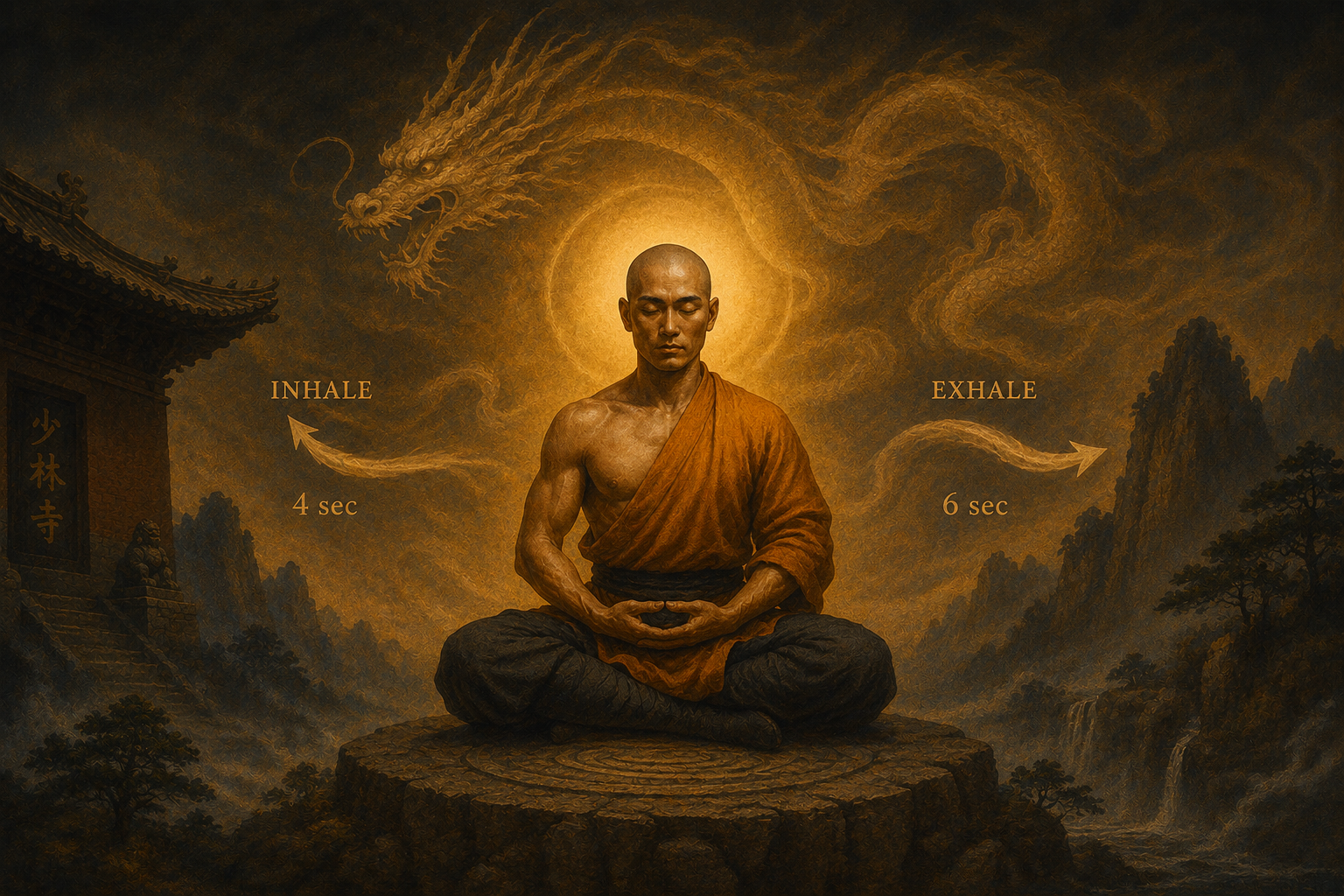
When it feels comfortable, use a smooth four-second inhale and a six-second exhale for five cycles. Let the longer exhale settle your tempo before the next action.
[ 004 — START NOW ]
The first practice is deliberately small. Do not chase a special state. Train a clean arrival, one anchor and one deliberate return.
Choose a stable position. Let the floor or chair carry your weight.
Soften the jaw, hands and shoulders without collapsing your posture.
Feel one natural breath sensation. When the mind leaves, notice and return.
Include the whole body, sounds and mood without needing to change them.
Ask: what is the next useful action? Open the eyes and move deliberately.
[ 005 — STILLNESS INTO MOVEMENT ]
Active meditation keeps deliberate attention while the body moves. Walking, standing, slow transitions and training become places to notice tension, pace the breath and preserve technique under pressure.
[ 006 — WHY THE PRACTICE MATTERS ]
Meditation can change your relationship with experience. By training attention, body awareness and the pause before reaction, you begin to perceive thoughts, emotions and everyday pressure from a steadier position.
Each time you recognise distraction and return, you practise directing attention instead of letting every thought, notification or impulse decide where it goes.
Breath and body awareness can interrupt automatic reactions, helping you meet pressure with greater steadiness and a more deliberate next action.
Meditation helps you notice thoughts, emotions, tension and urges as they arise—giving you the opportunity to understand them before acting.
Practice can change how experience is perceived: thoughts become events to observe, discomfort becomes information, and ordinary moments become easier to inhabit fully.
Standing, walking and moving meditation connect attention with posture, breath, balance and movement so presence becomes an embodied skill.
The real result appears beyond the session—in how you listen, handle criticism, recover from stress, train, work and choose your words.
[ 007 — PRACTISE WITH INTELLIGENCE ]
A strong practice is not rigid. Choose a position, duration and style that allows you to be alert, comfortable and consistent. The aim is not to endure a perfect pose—it is to develop awareness you can use.
Meditation is a personal-development practice. When professional health support is needed, it works alongside that care rather than replacing it.
[ 008 — SELECTED RESEARCH ]
Selected systematic reviews and meta-analyses that helped shape the evidence-informed foundations of the method. Every title opens the original journal record.
Goyal et al., JAMA Internal Medicine, 2014
Goldberg et al., Perspectives on Psychological Science, 2022
Kuyken et al., JAMA Psychiatry, 2016
Im et al., Clinical Psychology Review, 2021
Laborde et al., Neuroscience & Biobehavioral Reviews, 2022
Galante et al., PLOS Medicine, 2021
Rusch et al., Annals of the New York Academy of Sciences, 2019
[ THE COMPLETE METHOD ]
67 PAGES / 20 GUIDED PRACTICES / 28-DAY PROGRESSION
The complete beginner-friendly method integrates education, still meditation, breath awareness, standing, walking, recovery and meditation under pressure.
[ YOUR FIRST REP ]
You do not need a silent mind. You need one honest minute, one deliberate return and the willingness to practise again.